


ROBOTICS AND AUTOMATION
When should a factory use a sack handling robot?
Signs that sack handling is ready for automation, how a robot guided by a 3D AI camera works, and what to prepare.
Bizfix Lab · 21 November 2026 · 5 min read
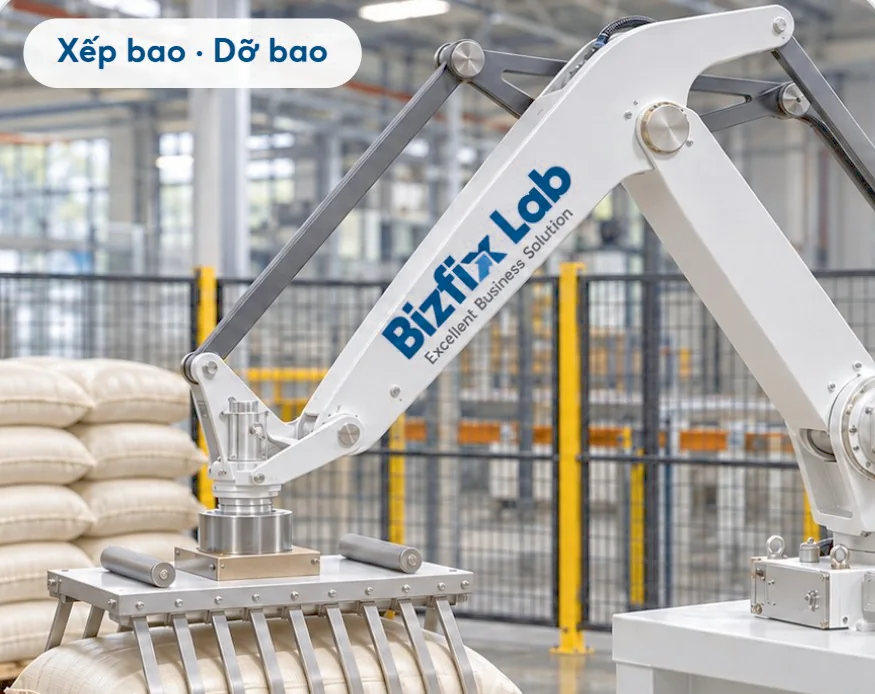
Manual sack handling: heavy, dusty and hard to pace
In animal feed, fertiliser, building materials, plastics and SPC flooring plants, sack handling is repeated thousands of times a day. The work is heavy and dusty, and because the pace depends on people, it is hard to keep steady across shifts.
Robots do not replace people everywhere. The robot takes the repetitive, heavy work; people move to supervision, inspection and exception handling.
Five signs it is time to consider a robot
- The line runs several shifts and needs to operate around the clock.
- It is hard to hire and keep people for heavy, dusty work.
- Handling output varies between shifts, making production hard to plan.
- Heavy sacks and constant repetition create safety risks.
- You need accurate output per shift and per zone to calculate costs.
How a robot guided by a 3D AI camera works
- See: a 3D laser camera scans the whole pallet and builds a depth map of every sack at 1,500 to 3,500 mm.
- Think: AI finds the position and rotation of each sack and plans a safe, collision-free pick.
- Act: the robot picks and places each sack; a vibration unit shakes off dust and empty sacks go to a collection bin.
- Continuous operation
- 24/7
- Continuous operation
- Automated, hands-free
- 100%
- Automated, hands-free
- Dust removed
- >99.9%
- Dust removed
Reference specifications
- Payload 50 to 200 kg, reach 2 to 3.5 m.
- Pick cycle of 6 to 15 picks per minute.
- 4 m slide table, adjustable to the floor layout.
- Accuracy under 1.0 mm, IP65 protection.
Actual specifications are chosen for each plant based on sack type, weight and floor space.
Start with an on-site survey
Before investing, a business needs two answers: does a robot fit the current process, and how long is the payback. Bizfix Lab visits your plant, analyses the actual process and answers both questions free of charge, with no obligation.